| |
Quick And Direct Information |
|
|
| |
|

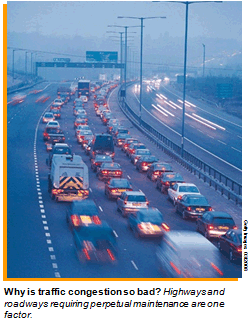 
- The average driver in metropolitan traffic
spends 61 hours per year stuck in traffic.
- Traffic congestion is costing the American
public about $65 billion per year.

One significant source of congestion is roadway construction, which accounts for 10% of all road-user delays. Road construction is necessary to keep up with the increasing demands of road-users, but there are ways to reduce delays by simply reducing the time of construction.

Placing (constructing) a concrete pavement takes only about 1/3 the time it takes to place a comparable flexible (asphalt) pavement. The reason? A flexible pavement must be placed in multiple layers and repeatedly compacted, while concrete pavements can be placed in one layer. Fresh concrete is typically transported to work zones in concrete trucks. The concrete is then fed directly to a slipform paver, which places a continuous pavement at the specified thickness.
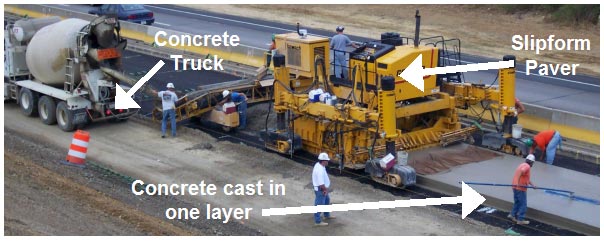
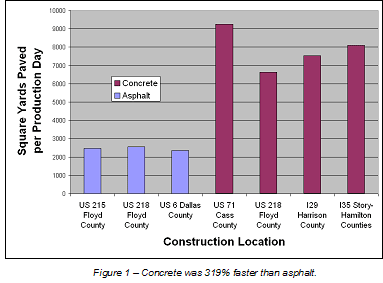 
A recent study measured the placement of asphalt and concrete pavements at seven different locations, all with similar designs.
The results of this study (Figure 1) show a 319% faster rate for concrete than asphalt. The average placement rate was 7,876 sq. yd. for concrete pavement and only 2,467 sq. yds. for asphalt.
Printer-Friendly Information: |
|

1.Traffic Congestion and Reliability: Trends and Advanced Strategies for Congestion Mitigation, Final Report, September 1, 2005. Prepared for the Federal Highway Administration by Cambridge Systematics, Inc. with the Texas Transportation Institute.
2.Schrank, D., Lomax, T., “The 2005 Urban Mobility Report”, Texas Transportation Institute, The Texas A&M University, May, 2005.
3.Cunningham, J., “How Fast Can We Build It – A Completion Time Comparison – PCC vs. HMA”, Project Report #25, Iowa Concrete Paving Association, November, 2001
|
|
|
|








 Tel. 847.966.2272