| |
Quick And Direct Information |
|
|
| |
|

Overlaying Concrete with Noise Surfaces Increases Future Maintenance and Congestion…
The Arizona Asphalt Rubber Friction Course (ARFC) overlay program is often cited as a novel approach to solve tire/road noise. What isn’t mentioned is that it’s the nations largest pavement test section and that is why it is called the Quiet Pavement Pilot Program by the Federal Highway Administration (FHWA). The verdict is still out on this $41million experiment and that is why FHWA has only agreed to accept it as a test program. The initiative was launched without regard to life cycle costs nor a inexpensive way to rehabilitate the surfaces in the future.
You Can’t Turn Back Time…
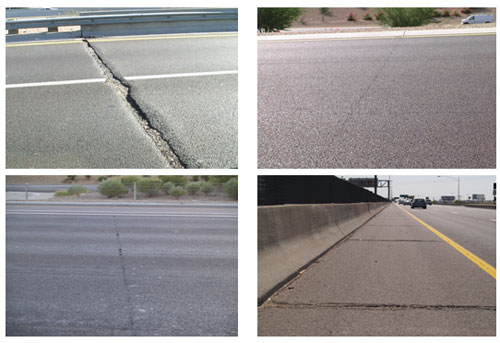
The two photos at the top indicate the distress evident on Arizona’s ARFC after only two years in service. The upper left photo is from I-10 in Phoenix and the upper right is on SR202. All the freeway overlays are experiencing reflective cracking at the locations of joints. The photo in the lower left is a bridge joint after only 2 years in service. The photo in the lower right shows the tenting that occurs on these highways after several years of service. This location is 7-8 years old, and would pose a snowplow hazard in Northern climates.
Durability Concerns
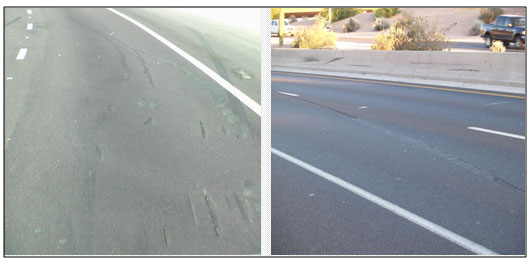
The photos above indicate road damage that occurs with open graded friction courses. Unlike concrete which typically does not incur road damage, friction courses tend to ravel upon contact with heavy sharp objects as often occurs in accidents. Unfortunately there is no successful way to repair the damage short of milling out the area and relaying new materials using paving equipment. This requires lane/roadway closures and significant equipment and labor. Since the durable concrete surface has been replaced by a soft, high binder content surface, road damage is inevitable. The photo on the above right shows an attempted repair that is already failing.
ARFC Performance Issues
- Road Damage Susceptibility
- Raveling
- Clogging with Debris
- Reflective Cracking
- Splash Spray
- Shoulder Tenting
- Bleeding at Transverse Joints
- Difficulty of Repair
- Stripe Obliteration
|
Important Considerations and Environmental Issues
- Thin overlays for noise reduction are costly to maintain
- Dark surfaces contribute to the Urban Heat Island Affect
- Dark surfaces reduce nighttime visibility (a driver hazard)
- Inability to place ARFC in temperatures below 85° F� limits practical use for most of the country
|
Concrete pavements offer a better alternative!
Printer-Friendly Information: |
|








 Tel. 847.966.2272